
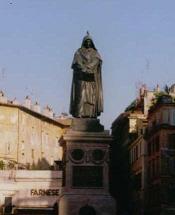
Giordano Bruno was a middle-ages radical, who as a travelling teacher (one who could perform stunning feats of memory) with outspoken anti-scholastic and anti-aristotelian views and a pantheistic vision of infinite universe. He was ultimately charged with heresy by the inquisition and burned to death.
"The universal Intellect is the intimate, most real, peculiar and powerful part of the soul of the world. This is a single whole which filleth the whole, illumineth the universe and directeth nature to the production of suitable species: this is concerned with the production of natural things, as our intellect with the congruous production of rational kinds. This is called by the Pythagoreans the motive force and mover of the universe, as said the poet [Virgil]:`Mind moveth the whole form and mixeth itself throughout the body.'" Giordano Bruno
Monotheist and pantheist view of the universe posed in contrast with Aristotelian division between form and matter, which he defines as two aspects of the same substance, i.e. nature, that he celebrates as divine creation and describes as united and infinite. His views are strongly influenced by Copernicus and Brahe's theories, which he supported against the officially prevailing geocentric scholasticism.
Bruno is seen is this regard as a forerunner of spinozianism.
