
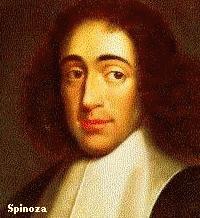
Within Spinoza's theology lies a profound materialism and it is for this that he has become a cause celebre for recent (French) philosophy. For Deleuze, Guattari, Balibar and Althusser the rejuvenation of Spinoza was more or less an explicit attempt to find an alternative to Hegel on which to ground materialist philosophy.
What Spinoza's philosophy represents, especially for a thinker like Negri, is a radically immanent theory. That is to say the reality of things is not given by some transcendent higher power, a God external to the world. Things are causa sui, the result of themselves, and God is the primary cause of all things, but God exists in the world, and is substance of infinite attributes - that is to say infinite number of ideas and means of conceiving him. He is 'supremely perfect and absolutely infinite'.
Spinoza's method is one of presenting propositions, axioms and definitions that are then proven. Hegel argues that in Spinoza's thought there lies no internal coherence between these proofs. Yet Spinoza's philosophy is holistic and some have argued that the organic interdependence of the parts is the basis of his philosophy. What distinguishes it from someone like Hegel is all things are evident or deducible from the primary cause and do not progress through contradiction as in dialectics. Parts of the whole pre-exist it (how does this square with God as absolute?) so the totality is of the Cartesian variety, especially in respect to the ultimate concord between the parts, they agree with one another.
